

You are a non-European company and you use Incoterm DDP for your sales to France and Incoterm EXW for your purchases from France? You are likely to act as an IOR/EOR on French territory and to have certain VAT obligations.
An Importer of Record (IOR) is the company legally named on the customs import documents as responsible for bringing goods into a country — it pays (or self-assesses) the import duties and VAT. An Exporter of Record (EOR) is its mirror image on the export side. Which of your business or your trading partner ends up holding these roles depends almost entirely on the Incoterm you use (DDP or EXW), and it directly determines whether you need to register for VAT and appoint a fiscal representative in France.
What is an Importer of record (IOR)?
The Importer of Record (IOR) is the local or foreign company legally responsible for importing goods into a given country. Named on the customs import documents, the IOR is responsible for filing the required import documentation (including any licenses and permits) and for the payment of import duties and taxes, VAT included.
In practice, being the IOR is not a title a company chooses freely: it flows directly from the Incoterm used on the sale (more on this below), and it comes with a concrete VAT consequence: since 1 January 2022, import VAT in France can no longer be paid at customs and must instead be self-assessed (reverse charge) on the importer’s French VAT return (CA3).
What is an Exporter of record (EOR)?
The Exporter of Record (EOR) is the local or foreign company legally responsible for the export of goods out of a given country. The EOR is responsible for filing the customs export documents (including licenses and permits) and bears the risks associated with exporting.
Since 2020, a company that isn’t established in the Customs Territory of the Union (TDU) can no longer act as exporter of record directly, even if it holds an EORI number. It must designate an operator established in the TDU to act as exporter in its place. In practice, this is often the company’s own fiscal representative.
IOR vs EOR vs EAR vs RCR vs fiscal representative: how they differ
IOR and EOR are the two roles that matter most in this article, but they regularly get confused with three other terms that sound similar but do genuinely different jobs. Getting this wrong is a common and costly mistake, so it’s worth laying them out side by side.
| Role | What it actually does | Who can hold it | How it's different |
|---|---|---|---|
|
IOR (Importer of Record) |
Named on the import customs declaration; responsible for import compliance and for the duties/VAT due on entry |
In practice, this needs to be an entity able to meet French/EU import obligations — often the buyer, or the seller under DDP via a customs representative |
A customs-facing role, tied to the import declaration itself |
|
EOR (Exporter of Record) |
Named on the export customs declaration; responsible for export compliance |
Must be established in the EU customs territory; non-EU companies must appoint one |
A customs-facing role, tied to the export declaration itself |
|
EAR (European Authorised Representative) |
Represents a non-EU manufacturer for EU product-compliance obligations (e.g. CE marking, medical devices) |
An EU-based legal entity, but for product regulation, not customs |
A regulatory/product-compliance role : not a customs or VAT role at all, despite the similar-sounding acronym |
|
RCR (Registered Customs Representative) |
Files customs declarations on behalf of an operator, either in that operator’s name (direct representation) or in its own name (indirect representation) |
EU-established customs agents; indirect representation becomes mandatory once the underlying operator isn’t EU-established |
A procedural role: the RCR acts for the IOR/EOR, it doesn’t replace the need to have one |
|
Fiscal representative |
Handles VAT registration, returns and payment on behalf of a non-EU business |
Specialised firms approved for this role (Easytax included) |
A VAT-only role. It doesn’t cover customs declarations, which is why a non-EU business often needs both a customs representative and a fiscal representative at the same time |
In practice, this is where things get complicated for a non-EU company: the IOR/EOR question decides whether you clear customs at all, while the fiscal representative question decides whether your VAT is handled correctly once the goods are through. Missing either one can block a shipment or trigger a VAT reassessment months later.
What are DDP and EXW Incoterms, and why do they decide who is IOR/EOR?
Whether your business ends up as the IOR, the EOR, both, or neither is determined almost entirely by the Incoterm used on the sale.
- Delivered Duty Paid (DDP): the seller bears all transportation costs, customs clearance (including the payment of duties and taxes), and all risks until the goods are made available to the customer. DDP places the least responsibility on the buyer — and the most on the seller, who typically ends up acting as IOR.
- Ex-Works (EXW): the seller leaves all transportation costs, customs clearance (including the payment of duties and taxes), and all risk to the buyer, from the seller’s own premises onward. EXW places the least responsibility on the seller and the most on the buyer, who typically ends up handling (or arranging) the EOR role on export.
IOR, EOR, DDP and EXW in practice: four examples
1. DDP sales by a foreign company in France
A Chinese company sells to its French customers under the DDP Incoterm. As we’ve seen, DDP means the seller takes on customs clearance in France as well as the payment of import duties and taxes.
For the buyer, this is straightforward: they take on no risk and have no customs formalities to deal with, and they know the full cost of their purchase upfront, with no hidden charges.

Customs: the Chinese seller acts as IOR on the import customs documents. It must handle the French import formalities and hold a European EORI number.
VAT: by acting as importer in France, the Chinese company is responsible for paying import duties and taxes, including VAT. Since import VAT can no longer be paid at customs, it must register for VAT in France through a French fiscal representative and self-assess the import VAT (reverse charge) on its French VAT return (CA3).
2. Setting up a storage of goods in France
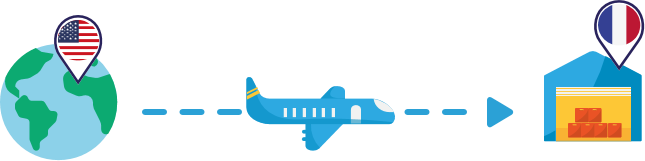
An American company sets up a stock of goods in France to serve its European customers. Storing goods locally means faster delivery and grouped shipments instead of piecemeal ones — which sharply reduces the number of import formalities (and their cost).

Customs: the American seller acts as IOR on the import customs documents, handling French import formalities and holding a European EORI number.
VAT: as importer in France, the US company must pay import duties and taxes, including VAT — so it must register for VAT in France through a French fiscal representative and self-assess the import VAT.
3. EXW purchase by a foreign company from a French supplier
A Canadian company buys goods from a French supplier under the EXW Incoterm. Because transport and formalities are entirely managed by the buyer, it has full visibility over logistics and delivery.

Customs: the Canadian buyer is responsible for the export formalities. But since 2020, a company not established in the EU customs territory can no longer act as exporter of record itself: it must designate an EU-established operator to act as exporter on its behalf, often its own fiscal representative.
VAT: by taking charge of the export from France, the Canadian company must, through its fiscal representative, declare an export of goods on its French VAT return (CA3). It can invoice its customer without VAT under Article 262 I of the French General Tax Code (CGI).
4. Cross-trade: France to Switzerland via a US intermediary
An American company trades internationally, buying batches of goods from French suppliers (EXW) and reselling them to a Swiss company (DAP). Shipping directly from the French supplier to the Swiss customer cuts delivery times, transport costs, and the number of customs formalities involved.
Customs: the US company handles the export formalities. As above, since 2020 it can no longer act as exporter of record directly and must designate an EU-established operator to do so on its behalf.
VAT: through its fiscal representative, the US company declares the export of goods on its French VAT return (CA3) and can invoice its Swiss customer without VAT (Article 262 I of the CGI). It can also directly deduct the French VAT paid to its French supplier on that same French VAT return.
No. The IOR is a customs-facing role tied to the import declaration; the fiscal representative handles VAT registration, returns and payment. A non-EU business often needs both at once, especially since import VAT in France must now be self-assessed rather than paid at customs.
Generally, no. A non-EU company typically needs its EU-established customer to act as IOR (common under DDP), or must appoint an EU-established representative to fulfil that role for it.
Customs can hold, delay, or reject the shipment. Without a party legally responsible for the import declaration and the associated duties and VAT, the goods simply cannot clear.
Often, yes. The customs representative (RCR) files your customs declarations; the fiscal representative handles your VAT obligations. They can sometimes be the same organisation, but they are legally two different roles.
They’re easy to confuse because of the similar acronym, but they cover completely different ground. The EOR is a customs role for exporting goods. The EAR (European Authorised Representative) is a product-compliance role — representing a non-EU manufacturer for EU regulatory obligations such as CE marking, unrelated to customs or VAT.
DDP (Delivered Duty Paid) — the seller takes on customs clearance and import duties/taxes, and typically ends up as IOR.
EXW (Ex-Works) — the buyer takes on transport, customs clearance and risk from the seller’s premises onward, and typically ends up handling (or arranging) the EOR role.
Whether you end up as an Importer of Record, an Exporter of Record, both, or neither comes down to the Incoterm on your sale. DDP pushes the customs and VAT burden onto the seller; EXW pushes it onto the buyer. Either way, since 2020 a non-EU company can no longer act as its own exporter of record, and since 2022 import VAT in France must be self-assessed rather than paid at customs, which in most cases means registering for VAT through a French fiscal representative.
Setting up new international operations and want to know the VAT consequences? Rely on Easytax’s experts to review your VAT registration obligations and manage your fiscal representation, or subscribe to our VAT hotline offer for ongoing support.